Care & Responsibility
- The Little Red Hen
- The Elves and the Shoemaker
- The Shoemaker and the Tea Party
- The Pancake
The story shelf
Classic tales and gentle Grimm stories, written out for family read-aloud. Repeat the week's story until the children can tell it back to you.
Story bank
The stories to know by heart. Gentle, classic, and worth telling many times.
Read aloud texts
These are short public-domain style retellings for family read-aloud. Read the same story more than once in the week, then ask for a simple narration.
Monday story
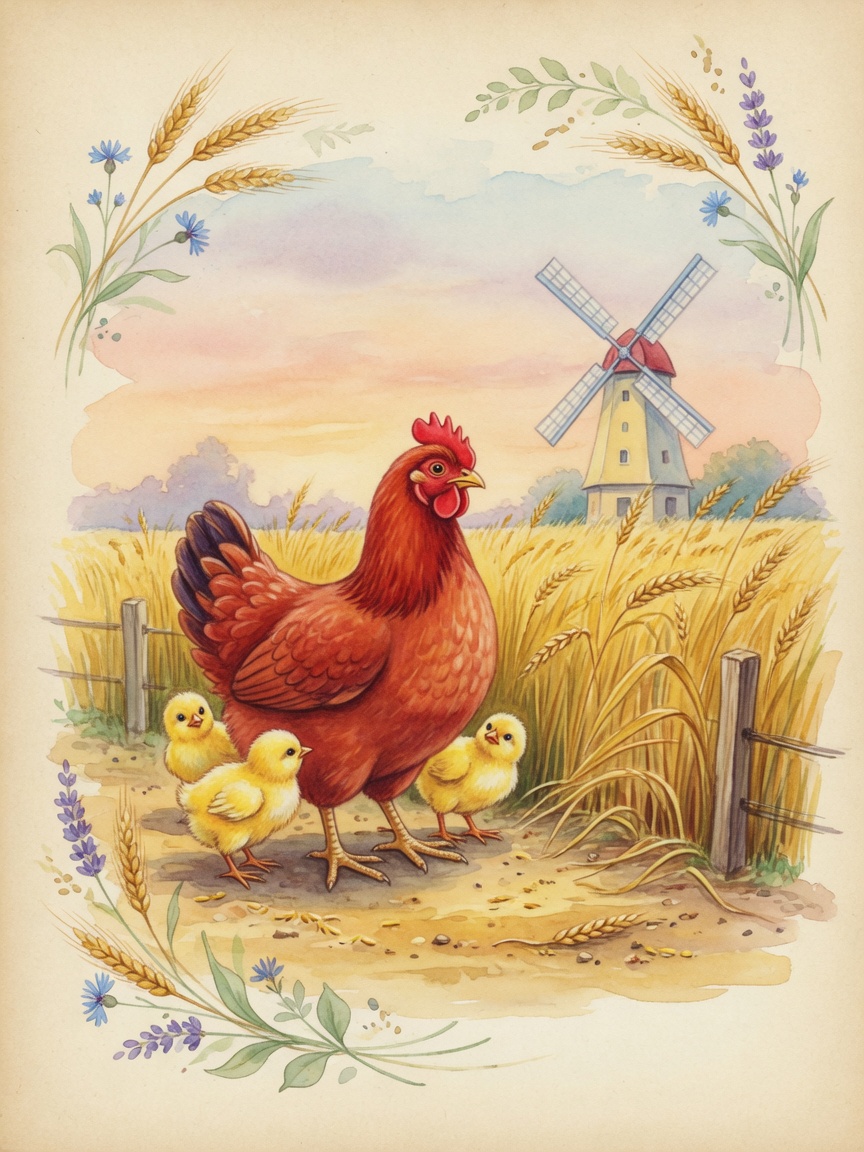
Once upon a time there was a little red hen who lived in a small yard with her friends: a sleepy cat, a lazy dog, and a duck who liked to wander.
One morning, while she was scratching in the earth, the little red hen found a few grains of wheat.
"Who will help me plant this wheat?" asked the little red hen.
"Not I," said the cat.
"Not I," said the dog.
"Not I," said the duck.
"Then I will plant it myself," said the little red hen. And she did.
The sun shone, the rain fell, and the wheat grew tall and golden. When it was ready, the little red hen said, "Who will help me cut this wheat?"
"Not I," said the cat.
"Not I," said the dog.
"Not I," said the duck.
"Then I will cut it myself," said the little red hen. And she did.
She tied the wheat into a bundle and carried it home. Then she said, "Who will help me thresh this wheat?"
"Not I," said the cat.
"Not I," said the dog.
"Not I," said the duck.
"Then I will thresh it myself," said the little red hen. And she did.
When the wheat was threshed, she said, "Who will help me take this wheat to the mill?"
"Not I," said the cat.
"Not I," said the dog.
"Not I," said the duck.
"Then I will take it myself," said the little red hen. And she carried the wheat to the mill, where it was ground into fine flour.
When she came home with the flour, she said, "Who will help me make this flour into bread?"
"Not I," said the cat.
"Not I," said the dog.
"Not I," said the duck.
"Then I will make it myself," said the little red hen. She mixed the flour with water and yeast. She kneaded the dough, shaped the loaf, and baked it until the whole kitchen smelled warm and good.
When the bread was done, the little red hen set it on the table. "Who will help me eat this bread?" she asked.
"I will," said the cat.
"I will," said the dog.
"I will," said the duck.
But the little red hen shook her head. "No," she said. "I planted the wheat, cut the wheat, carried the wheat, ground the wheat, mixed the dough, and baked the bread. I will eat it myself."
And she did. It was warm, sweet, honest bread.
The cat, the dog, and the duck smelled the bread and grew quiet. They began to understand that the magic of bread was not only in the oven. It was in the willing hands that planted, carried, ground, kneaded, and waited.
Narration: What jobs did the hen do? Why did the bread belong to her? What work can you help with today?
Tuesday story
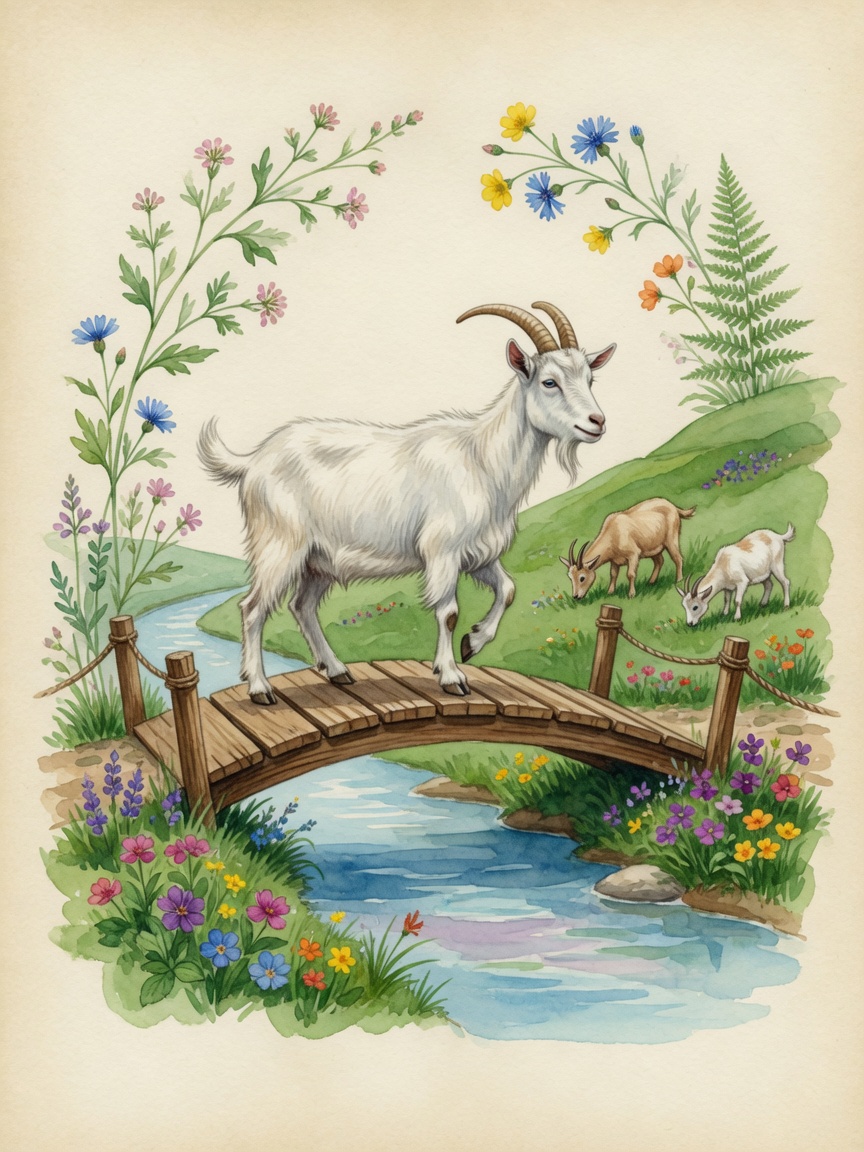
Once upon a time there were three billy goats, and the name of all three was Gruff.
They lived on a hillside where the grass had been eaten short. Across the river there was another hillside, and on that hillside the grass was long and green and sweet.
But between the two hills there was a bridge, and under the bridge lived a great ugly troll, with eyes as big as saucers and a nose as long as a poker.
One morning the three billy goats Gruff set out to cross the bridge and go up to the hillside to make themselves fat.
First came the youngest billy goat Gruff. He was very small, and his little hooves went trip, trap, trip, trap over the wooden bridge.
"Who's that trip-trapping over my bridge?" roared the troll from under the boards.
"Oh, it is only I, the tiniest billy goat Gruff," said the little goat, in a small voice. "I am going up to the hillside to eat the green grass."
"Now I am coming to gobble you up," said the troll.
"Oh no, pray do not take me," said the tiniest billy goat Gruff. "I am much too little. Wait a bit, and the second billy goat Gruff will come. He is much bigger than I am."
"Very well," said the troll. "Be off with you."
So the little billy goat Gruff crossed the bridge and went up the hillside.
After a while, the second billy goat Gruff came to cross the bridge. He was not so little, and his hooves went trip-trap, trip-trap, trip-trap over the planks.
"Who's that trip-trapping over my bridge?" roared the troll.
"Oh, it is I, the second billy goat Gruff," said the goat. "I am going up to the hillside to eat the green grass."
"Now I am coming to gobble you up," said the troll.
"Oh no, pray do not take me. I am not very big. Wait a bit, and the big billy goat Gruff will come. He is much, much bigger than I am."
"Very well," said the troll. "Be off with you."
So the second billy goat Gruff crossed the bridge and went up the hillside too.
Then came the great big billy goat Gruff. He was so heavy that the bridge creaked and groaned beneath him.
TRIP-TRAP, TRIP-TRAP, TRIP-TRAP went the great big goat.
"Who's that trip-trapping over my bridge?" roared the troll.
"It is I, the big billy goat Gruff," said the goat, and his voice was as loud as the troll's.
"Now I am coming to gobble you up," cried the troll.
"Well, come along," said the big billy goat Gruff. "I have two spears on my head, and I have four hard stones under my feet. Let us see who shall cross this bridge."
Then the troll climbed up onto the bridge. The great big billy goat Gruff lowered his head, stamped his hooves, and rushed at him.
He struck the troll with his horns, trampled him with his hard hooves, and tossed him over the side of the bridge into the rushing water below.
Then the great big billy goat Gruff crossed the bridge and went up the hillside, where his brothers were waiting for him.
There the three billy goats ate the green grass until they were full and round and happy. And if the grass has not all been eaten, they are eating there still.
Narration: Why did each goat cross the bridge? What did the little goat say to the troll? What made the biggest goat ready to face him?
Wednesday story
There was once a shoemaker who had become so poor that at last he had leather enough for only one pair of shoes.
He was an honest man and a careful worker. That evening he cut the leather neatly and laid the pieces on his bench, meaning to stitch them in the morning. Then he said his prayers, put out the candle, and went to bed.
When morning came, he went to his bench and stood still in wonder. The leather pieces were gone, and in their place stood a pair of finished shoes.
The stitches were small and even. The soles were firm. The leather shone softly. They were finer than any shoes the shoemaker had ever made.
Soon a customer came into the shop. He saw the beautiful shoes and liked them so much that he paid more than the shoemaker asked.
With that money, the shoemaker bought leather for two pairs of shoes. That night he cut the leather and laid it on the bench. In the morning, two finished pairs stood there, perfect and ready.
Those shoes also sold for a good price. Then he bought leather for four pairs. Again he cut the leather in the evening, and again the shoes were finished by morning.
This went on for many nights. The shoemaker and his wife were no longer hungry. Their fire burned warmer, their cupboard filled, and hope came back into the little shop.
At last the shoemaker said to his wife, "We must find out who is helping us."
So one night, instead of going to bed, they hid quietly in the corner behind a hanging cloth.
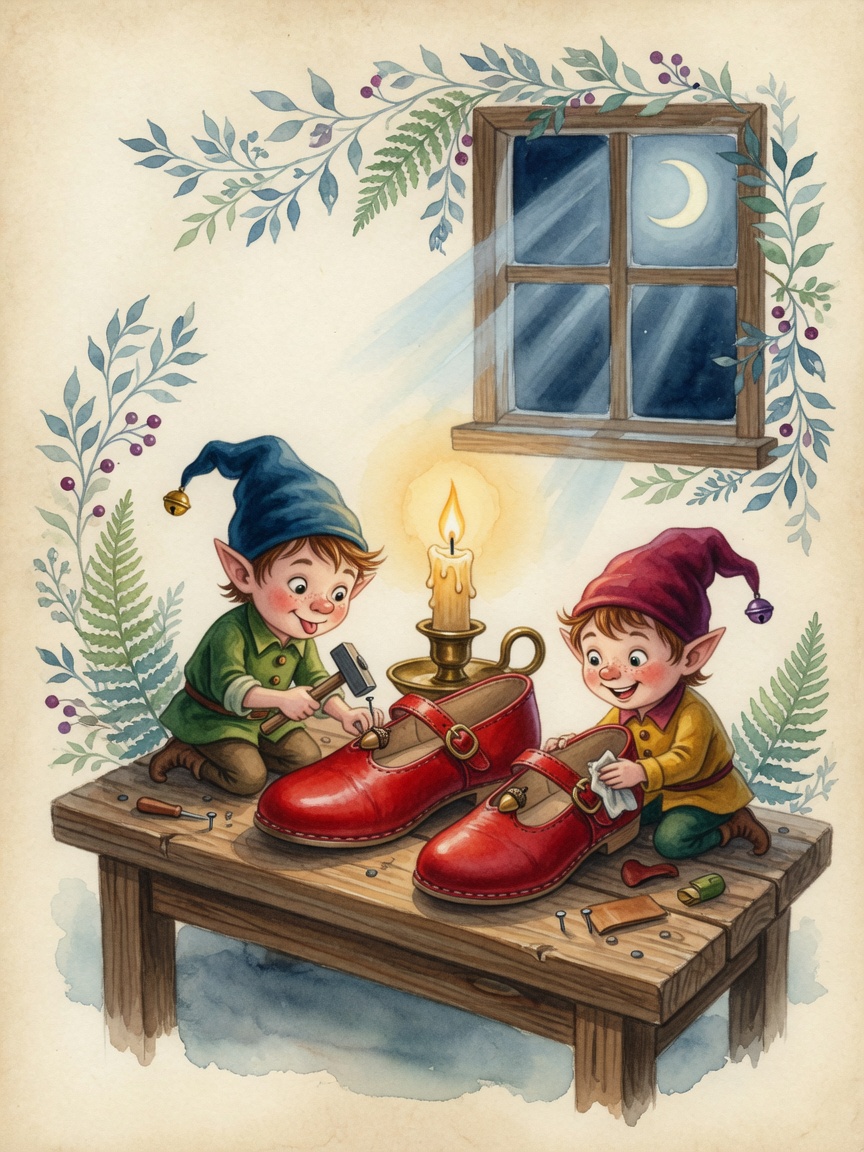
At midnight, two little elves came into the shop. They wore thin, ragged clothes, but their faces were bright and their hands were quick. They sat at the bench and began to work.
Stitch, stitch, tap, tap, pull, smooth, shape. The needle flashed, the thread tightened, the soles were set, and before the clock struck one, every pair of shoes was finished.
The shoemaker and his wife watched with grateful hearts.
In the morning his wife said, "Those little ones have made us rich enough. They are cold and have almost nothing to wear. I will sew them shirts, coats, trousers, and stockings."
"And I," said the shoemaker, "will make each of them a little pair of shoes."
All day they worked with love. That night they placed the tiny clothes and tiny shoes on the bench instead of leather, and then they hid again.
At midnight the elves came in. When they saw the gifts, they clapped their hands. They dressed themselves at once and looked so fine that they began to dance around the room.
They danced over the stools, over the chairs, and out the door into the moonlight, singing with joy. They never came back to make shoes, but the shoemaker prospered from that day forward.
The magic had moved through little hidden hands, and then through grateful hands. Help had come unseen; gratitude made it visible.
Narration: Who helped the shoemaker? Why did the shoemaker and his wife make gifts? What kind of hidden helpfulness can you offer?
Thursday story
Once upon a time an old man planted a little turnip seed in his garden.
He patted the soil over it and said, "Grow, little turnip. Grow sweet. Grow strong."
The rain watered it, the sun warmed it, and the old man weeded the earth around it. The turnip grew and grew. It grew bigger than a bowl, bigger than a basket, bigger than a barrel.
At last the old man said, "It is time to pull up the turnip."
He took hold of the green leaves and pulled.
He pulled and pulled, but the turnip would not come out.
So he called the old woman.
The old woman took hold of the old man, and the old man took hold of the turnip. They pulled and pulled, but the turnip would not come out.
So the old woman called the child.
The child took hold of the old woman, the old woman took hold of the old man, and the old man took hold of the turnip. They pulled and pulled, but the turnip would not come out.
So the child called the dog.
The dog took hold of the child, the child took hold of the old woman, the old woman took hold of the old man, and the old man took hold of the turnip. They pulled and pulled, but the turnip would not come out.
So the dog called the cat.
The cat took hold of the dog, the dog took hold of the child, the child took hold of the old woman, the old woman took hold of the old man, and the old man took hold of the turnip. They pulled and pulled, but the turnip would not come out.
So the cat called the little mouse.
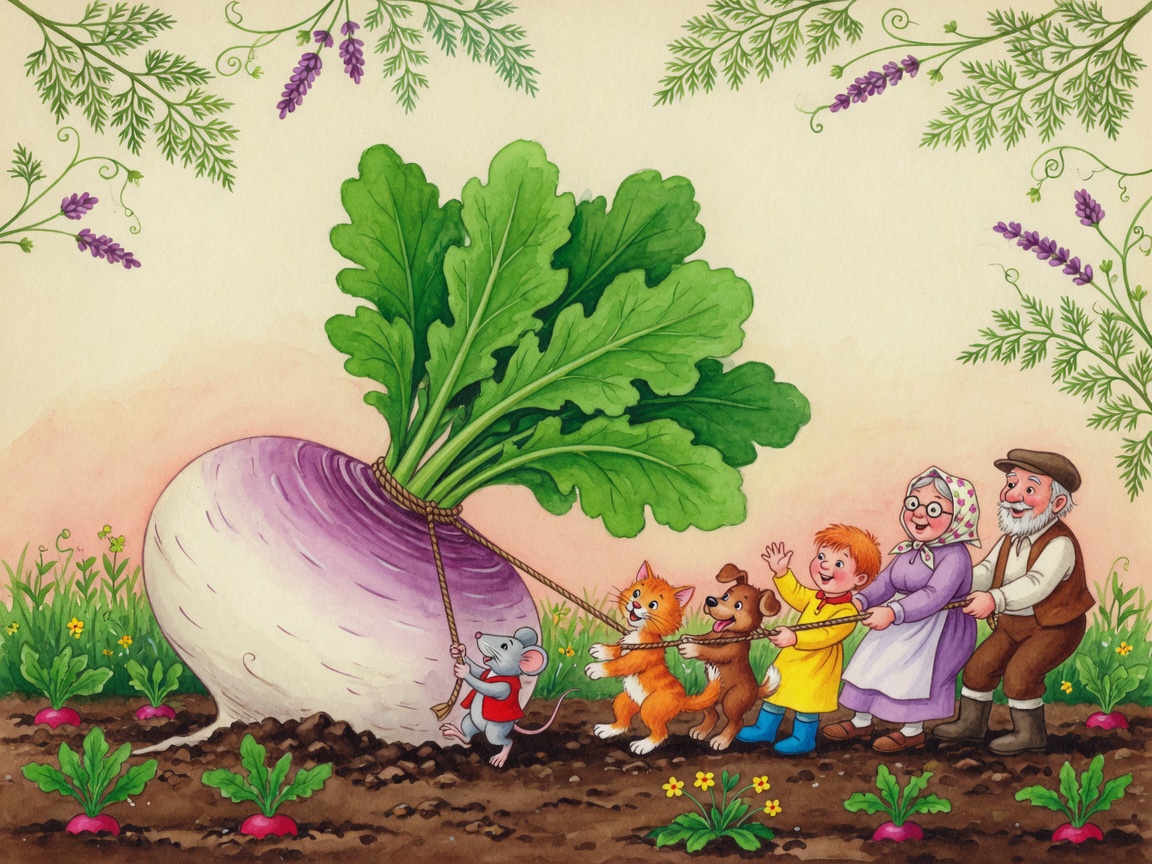
The little mouse took hold of the cat, the cat took hold of the dog, the dog took hold of the child, the child took hold of the old woman, the old woman took hold of the old man, and the old man took hold of the turnip.
They pulled and pulled and pulled.
Pop! Out came the turnip.
Everyone tumbled backward in a heap: the old man, the old woman, the child, the dog, the cat, and the little mouse.
Then they laughed, brushed off the soil, and carried the great turnip home.
That evening they made a great pot of turnip soup, and everyone had a bowl, even the little mouse.
The old man looked at the empty bowls and said, "The turnip was strong, but all of us together were stronger."
The magic had not belonged to one great hand. It had come when every small hand, paw, and tiny mouse-strength joined the same good work.
Narration: Who helped pull the turnip? Why did even the smallest helper matter? What happens when everyone adds their strength?
Friday story
Once there was a traveler who had walked a long road. His boots were dusty, his coat was thin, and in his pack he carried only an empty pot and one smooth stone.
As evening came on, he saw a village tucked between the fields. Smoke curled from chimneys, shutters were closing, and warm lamplight shone behind the windows.
"Surely someone here will have a little food to spare," thought the traveler.
He knocked at the first door. A woman opened it just a crack.
"Good evening," said the traveler. "I have walked far today. Could you spare a bite of supper?"
The woman looked at his empty hands and shook her head. "I am sorry. We have barely enough for ourselves." Then she closed the door.
He knocked at another door. An old man answered.
"Could you spare a crust of bread?" asked the traveler.
"Times are hard," said the old man. "There is nothing extra here." And he closed his door too.
Door after door gave the same answer. "Nothing to spare." "Not tonight." "Our cupboard is nearly empty."
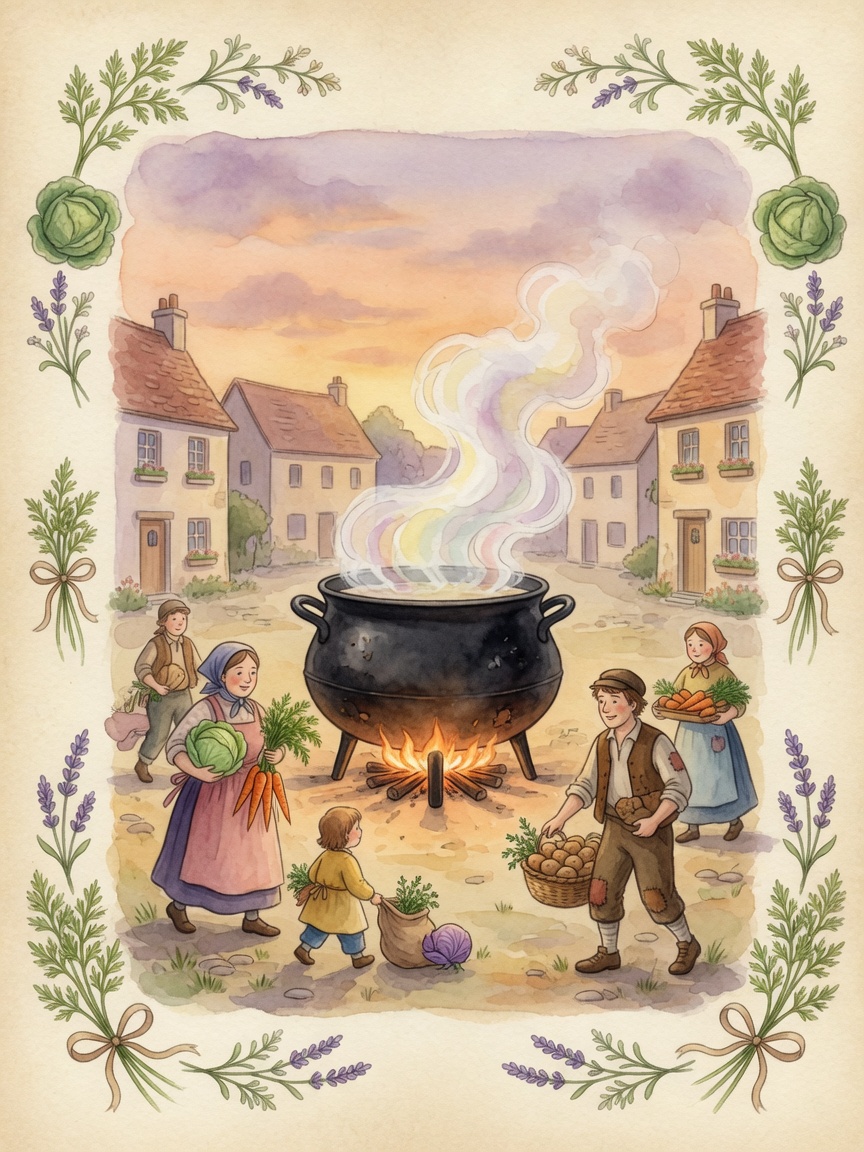
So the traveler went to the middle of the village square. He gathered a few sticks, made a small fire, set his pot above it, and filled the pot with water from the well.
Then he reached into his pocket, took out the smooth stone, and dropped it into the pot with a plunk.
A child peered from behind a gate. "What are you doing?" the child asked.
"I am making stone soup," said the traveler.
"Stone soup?" said the child. "Can you make soup from a stone?"
"Oh yes," said the traveler. "A very fine soup. It is good by itself, though it is even better with a carrot."
The child ran home. Soon the woman from the first house came back with one carrot in her hand.
"I found this at the bottom of the basket," she said. "It is not much."
"It is exactly right," said the traveler.
He chopped the carrot and dropped it into the pot. The water began to turn golden.
A man came closer and sniffed the steam. "What is cooking?"
"Stone soup," said the traveler. "It is already good, though it would be better with an onion."
The man rubbed his chin. "I may have one onion." He went away and came back with an onion wrapped in a cloth.
Into the pot it went.
Another neighbor came carrying two small potatoes. "These are a little soft," she said.
"Soft potatoes make kind soup," said the traveler, and he added them too.
Soon the village square smelled warm and savory. More doors opened. More people came out.
"I have a handful of beans," said one.
"I have a pinch of salt," said another.
"I have herbs from the garden," said a child, holding them carefully in both hands.
"I have a heel of bread," said the baker. "It is yesterday's bread, but it will still do."
"Everything will do," said the traveler. "Stone soup welcomes what is brought."
The pot bubbled gently. Carrot, onion, potato, beans, herbs, salt, and bread all gave what they had. The villagers stood close to the fire and watched the soup deepen.
Someone brought bowls. Someone brought spoons. Someone found a cloth for the table. Someone lit a candle. A little girl picked one flower and set it beside the pot.
At last the traveler tasted the soup. He closed his eyes and smiled.
"It is ready," he said.
They ladled the soup into bowls. The old man tasted first. "Why," he said, "this is the best soup I have eaten all winter."
The woman laughed. "And to think it began with a stone."
They ate together in the square while the stars came out. People who had closed their doors now sat side by side. Children dipped bread into their bowls. The candle burned low, and the pot grew empty.
When the last spoonful was gone, the traveler lifted the smooth stone from the bottom of the pot. He washed it carefully, dried it on his sleeve, and put it back in his pocket.
"May I see it?" asked the child.
The traveler placed the stone in the child's hand. It was warm from the soup.
"Is it magic?" the child whispered.
"In a way," said the traveler. "But the real magic was not in the stone."
"Where was it?" asked the child.
The traveler looked around at the empty bowls, the shared bread, the smiling faces, and the little flower by the candle.
"It was in what everyone brought," he said. "It was in the part of each person that knew how to give."
The next morning, when the traveler left the village, the people waved goodbye. Their cupboards were not full, but their hearts were lighter. They had learned that a feast can begin with almost nothing, if each person brings something to the pot.
And from that day on, whenever someone in the village made soup, they remembered the smooth stone and the night they discovered that supper tastes best when it is shared.
Narration: Why did the villagers say they had nothing to spare? What did each person bring? Was the magic really in the stone? What can you bring to the table today?
Saturday story

There was once a good, quiet girl who lived alone with her mother. They were poor, and one winter there was nothing left in the house to eat.
The girl went out into the forest to look for something for the table. There she met an old woman who already knew of her sorrow.
The old woman gave her a little pot and said, "When you say, 'Little pot, cook,' it will cook sweet porridge. And when you say, 'Little pot, stop,' it will stop again."
The girl thanked her and carried the little pot home to her mother, and now their hunger was over. They ate warm, sweet porridge as often as they wished.
One day the girl went out, and her mother said, "Little pot, cook." The pot cooked, and the mother ate until she was full.
Then she wished the pot to stop — but she had forgotten the words.
So the pot went on cooking. The porridge rose over the rim. It filled the kitchen, then the whole house, then the house next door, then the street, as if it meant to feed the whole world. And no one knew how to stop it.
At last, when only one little house in the village was left unfilled, the girl came home. She saw the rivers of porridge and said at once, "Little pot, stop."
The pot stopped cooking. And whoever wished to come back into the village had to eat their way through.
And nobody minded that at all, for the porridge was very good.
Narration: What did the little pot need to hear? Why is it important to remember both the beginning words and the ending words? What work in our house needs a good beginning and a good ending?
Sunday story

There was once a little girl whose father and mother had died, and she was so poor that she had no room to live in and no bed to sleep in. At last she had nothing left but the clothes she wore and a little piece of bread in her hand, which a kind heart had given her.
But she was good and gentle. And since she had no one in the world, she went out into the open country, trusting that heaven would care for her.
On the road she met a poor man who said, "Give me something to eat. I am so hungry." She handed him her whole piece of bread and said, "May it do you good," and went on her way.
Then came a child who cried, "My head is so cold. Give me something to cover it." So she took off her cap and gave it to the child.
A little farther on she met another child who had no warm jacket and was freezing, so she gave her own. And farther still, another asked for her dress, and she gave that too.
At last she came into a forest as night fell, and yet another child begged for her shift, and the good little girl thought, "It is a dark night. No one will see me. I can give this away," and she gave it.
And as she stood there with nothing at all left, suddenly the stars began to fall from the sky. And they were not stars, but bright round pieces of shining silver.
And though she had just given her shift away, she found she was wearing a new one of the finest linen.
She gathered the star money into it, and she was rich all the days of her life. And her heart, which had given everything away, stayed just as full.
Narration: What did the girl give away? What came back to her? Which feels warmer — keeping or giving?